

Migration Matters #15
Dear Reader,
We hope you are doing well. In this edition of Migration Matters, we look at the recent migration crisis in the EU, the decline in migration rates in the OECD countries and progress in the migration sphere discussed at COP26!
As always, please do share this edition and the newsletter and help us grow!
And now, on with Issue #15.
The Lede
First, let’s talk about the European migration crisis; in the past few months, trouble has been rumbling along the EU-Belarus border where several migrants were denied entry to the EU. It is observed that EU leaders failed to implement the Common European Asylum System in a unified manner. Belarus has been accused of ‘weaponising’ migration by looking to facilitate migration towards the European Union as a force to relax sanctions and as a penalty for its criticism of the forms of repression used against the opposition. Is it right to use such stereotypical language in the face of such a crisis?
READ: Aljazeera’s article on the future of refugees stranded between Poland and Belarus.
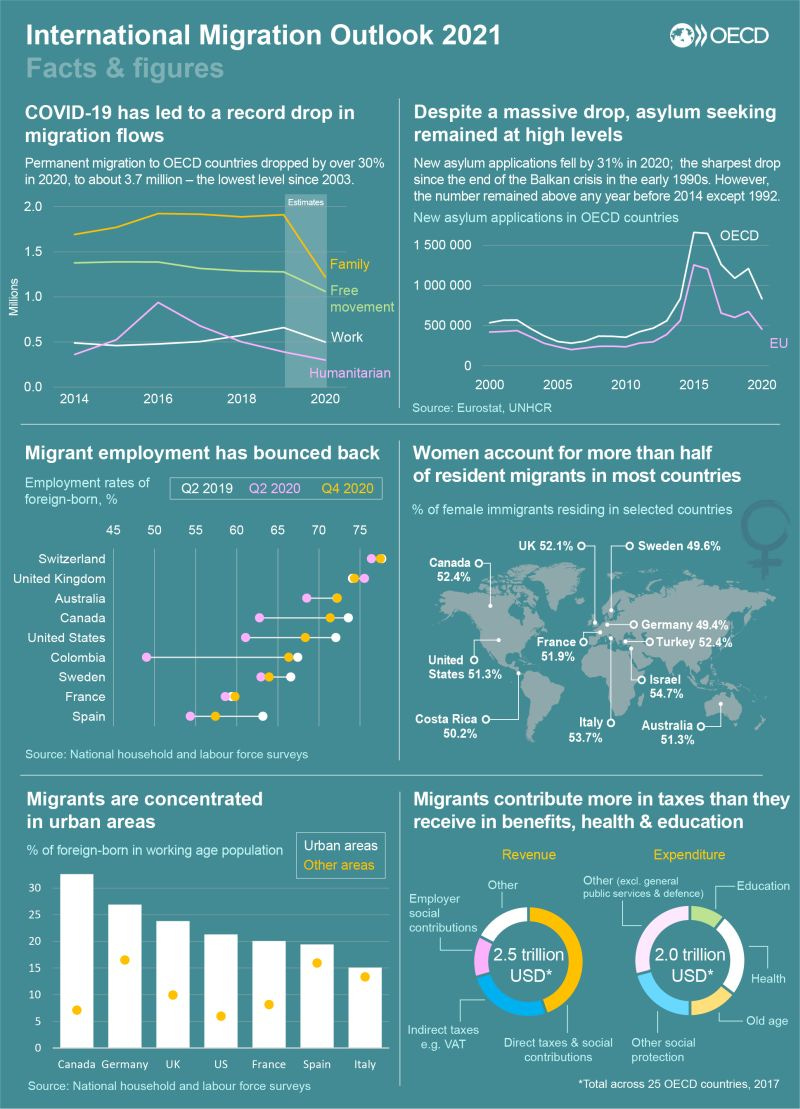
According to the latest OECD report, it has been observed that permanent migration to OECD countries fell by more than 30% last year. This statistic is the lowest recorded since 2003 and is attributed to the COVID-19 pandemic. Last year, around 3.7 million migrants entered the OECD member countries and this drop is well-reflected in several different categories. For example, family migration dropped by 35% while the temporary labour migration trend declined sharply with Canada, the USA, Australia, Japan and Korea showing the highest decline rates of up to -65%. Stefano Scarpetta, OECD Director of Employment, Labour and Social Affairs, mentioned that the post-pandemic recovery plans need to pay attention to immigrant integration, keeping in mind the several disadvantages they face in markets and societies.
Andrew Harper, Special Advisor on Climate Action to the United Nations High Commissioner for Refugees said “the world must turn COP26 words into action for forcibly displaced and stateless people”. Today, climate change is one of the pressing issues in the world and is a threat to individual safety, which can lead to increasing poverty and unsustainable access to livelihoods. The situation is even worse when nations don’t have the capacity to adapt, making refugees and displaced people vulnerable to this environmental threat. In Glasgow, the UNHCR called for action related to minimizing displacement, increasing support options for adaptions while addressing the loss and damage.
READ: World champion poet, Emtithal Mahmoud’s poem highlight how the climate crisis is a human crisis, especially for refugees and displaced people.
What Else?
In the UK, the Home Office has quietly tried to amend its draconian nationality and borders bill, while in Poland, the government has just passed an emergency law allowing authorities to turn back refugees who cross into the country “illegally”. Croatia and Greece are using a "shadow army," according to an international team of investigative journalists in south-eastern Europe. Unfortunately, many elected officials seem to regard relocation as a threat to civilization first and foremost. That was Boris Johnson's rationale when he argued – wrongly – that "uncontrolled immigration" was to blame for the fall of the Roman empire ahead of the opening of Cop26 in Glasgow.
Thousands of spouses of non-immigrant visa holders, such as H-1B and L-1 visa holders, would no longer have to worry about job gaps and financial hardship as a result of delays in the processing of their employment authorization documents. H-4 visa holders who timely file their EAD renewals will maintain their H-4 visa status and be eligible for a 180-day extension under the conditions of the settlement.
According to a study conducted by Odisha's Sambalpur University on migration, remittances, and human development in Western Odisha, the living conditions of migrant workers' families from western Odisha districts have not improved much despite remittances sent home from labouring in brick kilns or construction sites in southern Indian states."Around 97.9% migrant households said they use the remittance to purchase food, followed by the purchase of clothes for family members, house electrification, acquire drinking water facility, purchases of television, Cable connection and purchase home appliances".
Keir Starmer, a British politician and former lawyer who has served as Leader of the Labour Party and Leader of the Opposition since 2020, jumped into the newest round of this discussion on Friday. On the Sunday morning TV rounds two days later, the shadow home secretary, Nick Thomas-Symonds, was repeating many of the same ideas. This isn't a case of "incompetence," but rather of political decision-making. The administration has decided to shut routes that would allow refugees to securely enter the country.
Faraj, a 35-year-old Iraqi ethnic Kurd, hurried 190 kilometres from Minsk back to the dismal camp he had just left. Of course, the Polish border remained closed, and Faraj spent the next ten days in what he characterised as "something out of a horror movie." The EU has blamed the horrors of recent weeks on Belarus' autocratic leader, Alexander Lukashenko, who has offered strong backing to Poland's hardline stance against immigration.
Good Finds
Migration and Development Brief 35 by KNOMAD (The Global Knowledge Partnership on Migration and Development) talks about the COVID-19 recovery through a migration lens. It emphasizes developments related to Sustainable Development Goal (SDG) indicators through migration for which the World Bank is a custodian. It provides updates on migration and remittances trends throughout the world.
Here’s a New York Times article that discusses the accelerating pace of recruiting and training foreigners in several developed nations to actively cope with labour and workforce shortages. Through fast-track visas and permanent PR promises, a green flag is shown to the world to join these workforces.
A report prepared for the Euro-African Dialogue on Migration and Development (Rabat Process) and the International Centre for Migration Policy Development (ICMPD) as part of the partnership between MMC and ICMPD discusses the theme of ‘Urban Mixed Migration’ that involves experiences of migrants moving from West and North Africa.
Given the threat posed by the weaponisation of migration in recent times, this article deliberates upon the question of ‘migration interventionism’ by Western governments curbing those flows at the source. The article by RT Howard provides a holistic view of this issue by drawing case studies of the past with relevant analogies to the present.
Interested to know about the interrelationship between migration and economic benefits of a region? In “The Gift of Moving: Intergenerational Consequences of a Mobility Shock,” Emi Nakamura, Josef Sigurdsson, and Jon Steinsson investigate the long-term benefits of moving to a different region.
Are you planning to study in the EU and worried about mobility, documentation, etc? ICMPD’s “EU-India Student Mobility Podcast”, supported by the European Union, is a great place to learn more about various aspects of student mobility, visa process, scholarships, government support initiatives and life in Europe.
ALSO SEE: For a ready reckoner of the questions to consider and the steps to remember during the planning phase, refer to the EU-India Student Checklist!
And that is all for this edition of Migration Matters! We shall see you all again next month.
Best,
The IMN team
Research & Drafting: Chaarmikha Nagalla
Editorial Support: Nidhi Menon